Discovering the craft
Enamelling on lava, an art craft
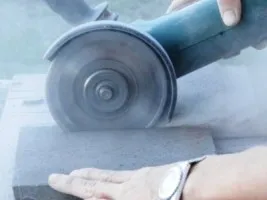
The stone of the Auvergne volcanoes as the base, enamel as the decoration. Carving, engraving and enamelling are different ways of bringing out the beauty of lava.
The base
Lava
Auvergne is rich in volcanoes. They shaped its landscapes and give it grand panoramas, lush vegetation, springs of great purity and rocks of many different compositions.
These volcanic rocks have many uses, lava in particular: building, civil engineering, crafts…
Among the particular qualities of lava are its great resistance to heat, and its resistance to cold too, as it is frost-proof. Set up outdoors, it therefore does not deteriorate.
The lavas of the workshop
The lavas used at the Émail et Merveilles workshop all come from lava flows of the Chaîne des Puys and the Massif du Sancy:
- Volvic stone
- Chambois
- Mont-Dore
The decoration
Enamels
These powders are made of alumina, silica and metal oxides, among other things, and they vitrify in the kiln, revealing their colours. Enamels can be matt or glossy, opaque or transparent, in plain colours or with effects.
They are used on many materials: clay, earthenware, porcelain, metals… and, as here at the Émail et Merveilles workshop, on lava.
The rise in temperature gives them, once cooled, a hardness that makes them extremely resistant to chemicals, weather, scratches… Depending on various factors, the firing is done at different temperatures.
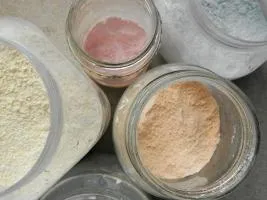
Powdered enamels 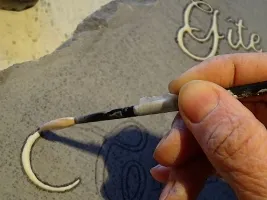
Applying enamel with a brush
Firing
Three firings, three temperatures
Enamels are powders made of alumina, silica and metal oxides, among other things. They vitrify in the kiln and reveal their colours; once cooled, they become extremely hard-wearing.
- 960–980°Enamels coloured through
The first layer fires at about 960 or 980°.
- ≈ 860°Vitrifiable colours
Applied over that first layer, they fire at about 860°.
- ≈ 750°Lustres
Gold, silver, copper, bronze… need a lower temperature, about 750°.
History
Enamelled lava through history
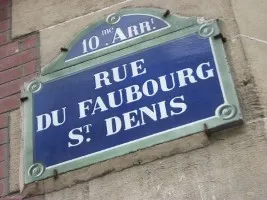
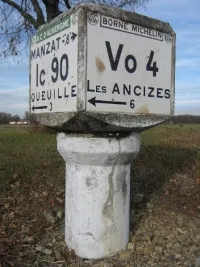
From the first enamelled tiles at the Sorbonne in 1824 to the street name plates of Paris, from viewpoint indicators to the Michelin road markers: two centuries of enamelled lava, up to the workshop in Jenzat.