Enamelled lava through history
The great works, from the Sorbonne to the roads of France, and on to the workshop in Jenzat.
-
1824
The beginnings, at the Sorbonne
Enamelled lava seems to begin in 1824 in the laboratory of the Sorbonne, with a man named Barruel who enamelled tiles of domite (lava from the flow of the Puy de Dôme).
Ferdinand Mortelèque, a chemist and porcelain painter, was encouraged to continue the research by Count Chabrol de Volvic, then prefect of the Seine and owner of quarries in Volvic. He made the first portrait in enamelled lava (the piece is now in the Musée Sahut in Volvic). Ceramists, glassmakers, engineers, painters… then took an interest in the technique and tried to develop it.
-
19th century
The street name plates of Paris
From then on, architects included enamel on lava in the façades of monuments and in the urban landscape, starting with the street name plates of the city of Paris, made by the Hachette company in Paris (Mr Hachette was Mr Mortelèque’s son-in-law).
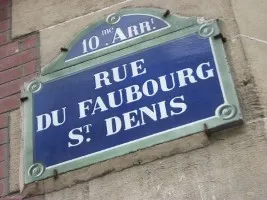
Rue du Faubourg-Saint-Denis, Paris 10th 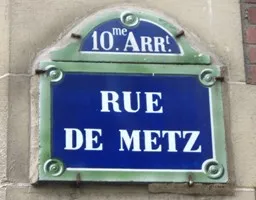
Rue de Metz, Paris 10th
-
1833 – 2011
The decoration of the church of Saint-Vincent-de-Paul
The architect Jacques Ignace Hittorff was particularly fond of the material and its finish. He decided to include it in the decoration of the church of Saint-Vincent-de-Paul in Paris, then being built: a monumental enamelled lava decoration framing the portal.
The project began in 1833 with models and drawings by Pierre Jules Jollivet; François Gillet was then put in charge of making the whole. But when it was installed in 1860, the drawings, thought daring, together with the bright colours and the shine of the enamel, caused a scandal, and it was taken down at once. Only in 2011 was this fabulous ensemble put back in place, as originally planned.
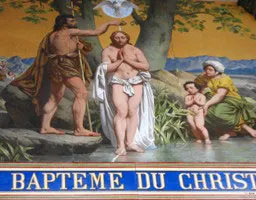
The Baptism of Christ, after Pierre Jules Jollivet 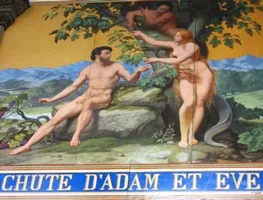
The Fall of Adam and Eve, after Pierre Jules Jollivet
-
Late 19th century
Signs, clocks and viewpoint indicators
At that time, signs and clock faces were also made in enamelled lava and then, at the request of the Touring Club, the first viewpoint indicators (tables d’orientation). The first was set up at Fourvière at the end of the 19th century; it was made by the Saint-Martin workshop near Riom, in the Puy-de-Dôme. Since then these tables have dotted our landscapes, helping us to read them and find our bearings.
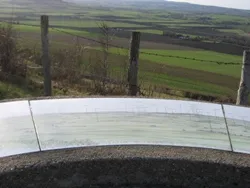
Viewpoint indicator at Ussel-d’Allier (Allier), made by the Orlat company, Ébreuil (Allier)
-
20th century
The first workshop in Auvergne
The Saint-Martin workshop, then run by Maurice Seurat, was the first lava enamelling workshop in Auvergne: until then the lava came from Auvergne, but the enamelling was done in Paris. In the 20th century the workshop grew considerably, exporting all over the world viewpoint indicators, water-level gauges, laboratory worktops and many pieces for signage, civil engineering, architecture…
-
1928 – 1970
The Michelin corner markers
In 1928 Michelin set up its own enamelling workshop and produced enamelled lava plates for road signs. In 1931 the Ministry of the Interior and Public Works adopted the Michelin corner markers for the main roads of France: four enamelled lava plates on a concrete post, which allowed the French to find their way on the road network. The workshop ran until 1970.
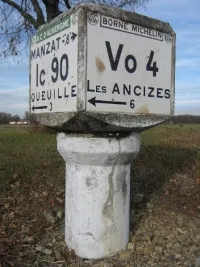
Corner marker in the commune of Saint-Georges-de-Mons (Puy-de-Dôme)
-
Around 1975
Photo-ceramics
A photo-ceramic technique was developed, which sets into the enamel a photo printed with vitrifiable metal salts. This step forward opened new perspectives, widening the possibilities and finishes.
-
1990
A course in Volvic
A course for enamellers on lava was created at the school of architecture in Volvic. The school later became the Institut des Métiers d’Art de la Pierre et de la Construction: IMAPEC.
-
2011 – 2012
My diploma, then the workshop in Jenzat
This course allowed me to learn this fascinating craft and to obtain a level IV diploma as an enameller on lava, a trade listed in the register of Métiers d’Art (art crafts). Straight after, I set up my workshop in Jenzat, Auvergne, in an old farmhouse a stone’s throw from the Sioule river.
-
2020
The Marque Auvergne
I joined the Marque Auvergne.
-
2023
On Radio Coquelicot
In an interview for Radio Coquelicot, I talked a little about my work. You can listen to the interview again on the Radio Coquelicot website (in French).
-
2024
A film on intangible cultural heritage
A report made by the Association nationale Cultures du Monde introduces the public to enamelled lava as part of the intangible cultural heritage of the region. Watch the film on YouTube (in French).